
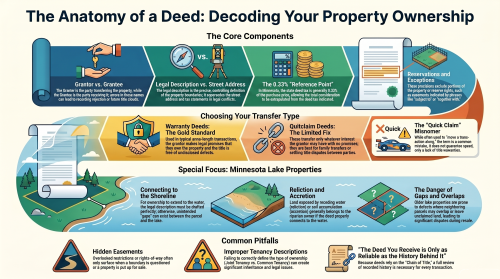
When buying or owning property, most people understand that the “deed” is important. Beyond that, there is often very little clarity about what a deed actually is, what it does, or why it matters.
That lack of understanding can lead to problems, especially when disputes arise or assumptions are made about ownership, boundaries, or rights to use property.
A closer look at the anatomy of a deed helps explain why it matters and what property owners should be paying attention to.
What a Deed Is and What It Is Not
At its core, a deed is a legal document used to transfer an interest in real property (convey title) from one party to another.
A deed is not, by itself, proof of perfect ownership. It is evidence of a transfer but it is one piece in the larger chain of title.
Ownership of real estate is established over time through a series of recorded documents. Each deed builds on the last. That is why title work, reviewing the full chain of ownership, is necessary in most transactions.
In other words, the deed you receive is only as reliable as the history behind it.
Why We Rely on Deeds
Despite their limitations, deeds are the primary way property interests are transferred and documented. Deeds identify the parties involved, describe the property, define the interest being transferred, and, when properly recorded, provide notice to the public.
Recording is critical. Minnesota a “race-notice” state. This means recording establishes priority and helps prevent competing claims. Without it, determining ownership would be far more uncertain.
Key Parts of a Deed
While deeds can vary in form, most contain several core components.
Grantor and Grantee. The grantor transfers the property. The grantee receives it. Errors here, particularly with names or entity designations, can result in the County Recorder rejecting the document from being recorded or, worse, can create issues down the road.
Legal Description. This is the most important, and most misunderstood, part of the deed. It is not the street address. It is not what appears on a county property tax statement. It is the precise legal definition of the property. Absent a dispute over adverse possession or a prescriptive easement, which has been a topic in past articles, if there is ever a conflict between what someone believes they own and what the deed says, the legal description controls.
Consideration. A deed is a form of conveyance and reflects the consideration of what was exchanged for the property. While often routine, it can have tax and interpretive implications. For instance, one practical way to estimate the actual purchase price is to look at the deed tax indicated on the deed. In Minnesota, the state deed tax is generally 0.33% (.0033) of the purchase price, so the total consideration can often be extrapolated from that figure. While not exact in every situation, it can provide a useful reference point.
Reservations and Exceptions. These provisions may reserve rights (such as easements) or exclude portions of the property. They are easy to overlook but can significantly impact use. In the case of easements, if a property is burdened by an easement it may have the phrase “subject to” or if it is benefitted by an easement it may have the phrase “together with” or if both “subject to and together with”.
Execution and Recording. Proper signatures and notarization are required for recording. Recording, in turn, is what gives public notice and protects the transaction.
Quitclaim Deeds vs. Warranty Deeds
Not all deeds are created equal. One of the most important distinctions is between a quitclaim deed and a warranty deed. A warranty deed is the standard for a typical arms length transaction. Quitclaim deeds are commonly used in limited contexts, such as transfers between family members, resolving title issues, or settling disputes.
A warranty deed provides assurances. The grantor is making legal promises that they own the property, have the right to transfer it, and that the title is not subject to undisclosed defects. If those promises turn out to be false, the grantee may have recourse against the grantor.
A quitclaim deed, by contrast, makes no such promises. It simply transfers whatever interest the grantor may have, if any. If the grantor owns the property, that interest transfers. If they do not, nothing transfers. That is what makes the quitclaim deed effective for resolving property disputes. If there is a dispute between Mike and Ike over a portion of Blackacre, and the settlement calls for Ike to give up any claim of ownership to any part of Blackacre, then Ike can do so by simple signing a quitclaim deed conveying title to the entirety of Blackacre to Mike.
Because of that, quitclaim deeds are often used in limited contexts, such as transfers between family members, clearing up title issues, or resolving potential claims.
They are sometimes casually referred to as “quick claim deeds,” usually in the context of wanting to move a transaction along. That is understandable but it is a misnomer.
Lake Property Considerations: Why Legal Descriptions Matter Even More
For lake property owners in Minnesota, the legal description takes on even greater importance.
In many cases, property is intended to extend to the shoreline. But that only works if the legal description is properly drafted. If it is not, it can unintentionally create gaps between parcels or leave uncertainty as to where ownership actually ends.
That issue becomes more significant because of how Minnesota law treats changing shorelines.
Under the concepts of reliction and accretion (gradual changes to the shoreline), land that becomes exposed over time, whether through gradual recession of water or accumulation of soil, generally belongs to the riparian property owner. In other words, if the shoreline moves gradually, the property line may effectively move with it.
But that principle assumes the underlying legal description properly connects the property to the water in the first place.
If there is a defect, gap, or ambiguity in the description, disputes can arise over whether the property actually reaches the shoreline, who owns newly exposed land, and/or whether neighboring parcels overlap or leave unclaimed areas.
These issues are not uncommon, particularly with older lake properties or parcels that have been divided and re-divided over time.
What appears straightforward on the ground — “my property goes to the lake, isn’t it obvious?” — is ultimately governed by what the deed actually says. Again, we can often “clean up” those gaps through other concepts that have previously been broken down.
Where Problems Arise
Most issues involving deeds are not obvious at the time of purchase. Due to the rush and excitement of closing, any problems from the deed tend to surface later, e.g. when property is sold, when a boundary is questioned, or when a dispute arises.
Common problems include legal descriptions that do not match assumptions about the property and improper descriptions of the type of tenancy (joint vs. common).
Other issues include overlooked easements or restrictions, reliance on a quitclaim deed where ownership was uncertain, and gaps or inconsistencies in the chain of title.
Bottom Line
A deed is a foundational document in real estate ownership but it is not always self-explanatory. Understanding what a deed does, what it contains, and the type of deed involved can help avoid costly misunderstandings.
For lake property owners in particular, careful attention to the legal description is essential. What happens at the shoreline, and over time, often depends on it. As is often the case, addressing these issues early is far easier than correcting them later, especially once a dispute arises.