
New Minnesota Laws Affecting Lake Use and Stewardship
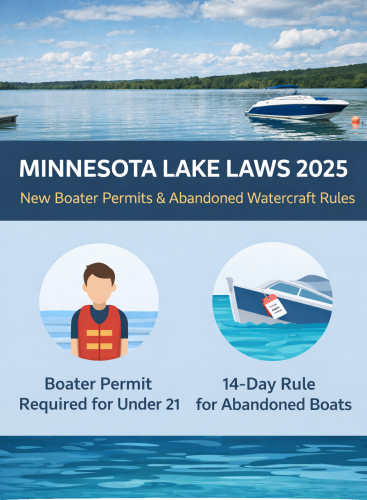
Minnesota summers revolve around lakes, where families and neighbors spend time on the water. Two new state laws took effect this summer that affect how watercraft may be used and stored. Both are currently in effect and apply broadly across the state.
Boater Education Permit Requirement for Operators Under 21
The first new law requires youth to hold a valid watercraft operator permit to operate motorboats or personal watercraft without supervision. This requirement went into effect on July 1, 2025. People born after June 30, 2004 (those under 21 per my Minnesota math) are now required to have this permit when operating motorized watercraft. If someone lacks the permit, they must operate only under the supervision of a qualified accompanying operator. In future years, the requirement will cover older age groups. Individuals born after June 30, 2000, must comply starting July 1, 2026. Those born after June 30, 1996, must comply beginning July 1, 2027. Finally, individuals born after June 30, 1987, must comply starting July 1, 2028. Bottom line is that people born after June 30, 2004, need the permit now, and that the requirement will expand gradually in the coming years.
A young operator under 12 years old may not operate any motorboat with more than 75 horsepower or any personal watercraft. A young operator may operate a low-powered motorboat under 75 horsepower, provided a qualified accompanying operator is aboard. The law defines this accompanying operator as a person at least 21 years old who is in the vessel, has immediate access to the controls, and either holds a valid operator permit or is an exempt operator.
If someone already holds the watercraft operator permit, they are not affected by the new law. Rentals are also regulated. Anyone 18 or older must have a valid permit to rent a boat or personal watercraft. Individuals under 18 are not permitted to rent such vessels.
To obtain the permit, individuals must complete an online boater education course and pass a test. After successfully completing the course and exam, a permit card is issued and must be carried when operating a motorized watercraft. The permit is valid for life.
Abandoned Watercraft
The second law addresses abandoned or neglected watercraft. If a vessel appears stranded, wrecked, or abandoned on public accesses or shorelines, officers may tag it and notify the owner. The owner then has 14 days to correct the condition. If the issue is not addressed within that period, the vessel may be seized and forfeited as abandoned property. Real authority is now granted to remove watercraft that block access, pose navigation hazards, or are left in a state of disrepair. The tagging and 14-day period are intended to give owners notice and time to respond before forfeiture may occur.
Homeowners should keep boats registered, maintained, and visibly in use to avoid misunderstandings. If a boat is tagged, the owner may need to show documentation that it is still in use or was only temporarily located there. Lake associations can assist by reminding members of the fourteen-day rule and encouraging proper stewardship of watercraft.
Conservation officers and county sheriffs enforce both new laws. The operator permit law is enforced similarly to driver licensing enforcement, and during checks, the permit must be presented on demand. Carrying the permit when operating a vessel remains essential. The abandoned watercraft law establishes a timeline for removal and permits forfeiture without the need for court proceedings. Keeping watercraft in clear working condition, properly registered, and not left at public access points is critical. Owners who store boats near shared access points or shoreline areas may consider posting notices or signage to prevent any misunderstandings.
By following these requirements, homeowners can avoid citations, forfeitures, or disputes. Staying informed about the legal requirements helps communities continue to use Minnesota’s lakes effectively and without interruption.
- SPL