Conditional Use Permits and Variances: What Minnesota Property Owners Need to Know

In various communities and counties in Minnesota, a conditional use permit allows a property owner to use land in a way that is permitted under local zoning rules only if certain conditions are met.

Local zoning ordinances regulate how land can be used and where structures can be placed. These rules help communities maintain orderly development, protect natural resources, and preserve neighborhood character. But sometimes a property owner’s plans simply do not fit neatly within the zoning code.

When that happens, the solution is often one of two things: a Variance or a Conditional Use Permit (CUP).

Understanding the difference between these tools can help property owners navigate the approval process more efficiently.
A Common Scenario

Imagine you are ready to build the large pole shed you have always wanted—big enough to store an RV, snowmobiles, a wake boat, and all the gear that comes with lake living. After submitting your plans, you learn the building would sit ten feet inside the required setback from the road.

There is no other practical location on the property to place the structure. What now?

Or consider a different situation. You purchase a beautiful lake property and work with an architect to design a building where you and your adult children can each have separate living quarters—essentially a small multi-family residence. When you approach the county about permits, you are told that this type of development requires a Conditional Use Permit.

In both examples, the property owner must seek special permission from the local zoning authority. Depending on the circumstances, that permission will come in the form of either a variance or a conditional use permit.

What Is a Variance?

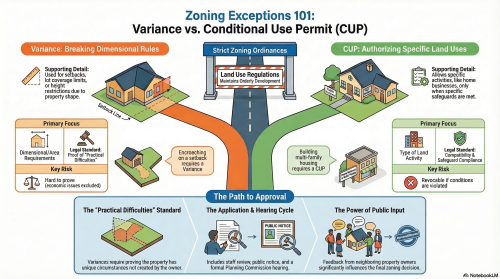
A variance allows a property owner to deviate from certain zoning requirements when strict compliance with the ordinance would create practical difficulties.

In Minnesota, most variances involve area requirements, such as:

  • setback distances
  • lot coverage limits
  • building height restrictions
  • other dimensional regulations

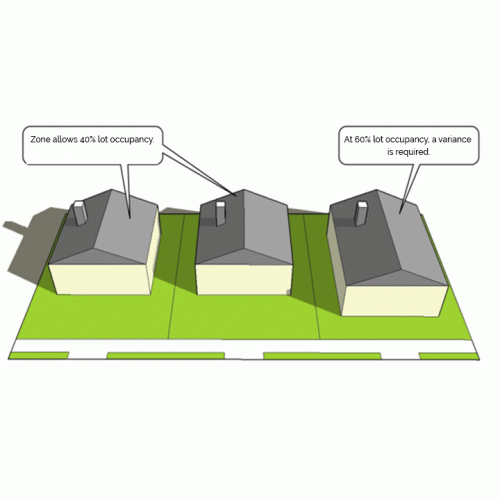
For example, if a structure is otherwise allowed in the zoning district but cannot meet the setback requirement due to the shape or features of the property, an area variance may be appropriate.

Minnesota law requires applicants to meet the “practical difficulties” standard, which generally means:

  1. The proposed use of the property is reasonable.
  2. The difficulty is caused by circumstances unique to the property, not created by the landowner.
  3. Granting the variance will not alter the essential character of the locality.

Importantly, economic considerations alone are not enough to justify a variance.

In the pole-shed example above, the structure itself is likely permitted in the zoning district. The issue is simply that the proposed location does not comply with the setback requirement. In that situation, the owner would typically apply for an area variance.

What Is a Conditional Use Permit (CUP)?

A Conditional Use Permit is different. Instead of allowing an exception to a dimensional rule, a CUP authorizes a specific type of land use that the zoning ordinance allows only under certain conditions.

Many zoning ordinances identify uses that may be appropriate in a district if certain safeguards are satisfied. These are called conditional uses.

Common examples include:

  • multi-family housing in certain districts
  • commercial activity in limited locations
  • shoreland development
  • planned unit developments
  • certain home-based businesses

When a CUP is granted, the local government typically attaches conditions to ensure the use remains compatible with surrounding properties. These conditions might regulate:

  • building design
  • landscaping and screening
  • traffic access
  • lighting or noise controls
  • environmental protections

If those conditions are violated, the permit can potentially be revoked.

The Application and Approval Process

Although they address different issues, variance and CUP applications follow similar procedures.

Typically the process includes:

  1. Submitting an application to the zoning administrator
  2. Staff review and preparation of a report
  3. Public notice and a hearing before the Planning Commission
  4. A recommendation or decision by the Planning Commission or governing body

During the hearing, the commission may consider factors such as:

  • compatibility with neighboring properties
  • impact on public health and safety
  • environmental concerns
  • adequacy of water and septic systems
  • traffic and access considerations

Public input—especially from neighboring property owners—often plays a significant role in the process.

Why Early Planning Matters

Whether a project requires a variance or a conditional use permit depends on several factors, including:

  • the type of development proposed
  • the zoning classification of the property
  • the specific language of the applicable zoning ordinance

Because zoning regulations vary widely between municipalities and counties, property owners are wise to consult the local zoning administrator or a real estate attorney early in the planning process. Addressing zoning issues before investing heavily in design or construction plans can save substantial time and expense.

Final Thoughts

Zoning ordinances are designed to protect communities, but they also include mechanisms to accommodate reasonable property use. Variances and conditional use permits provide flexibility when strict application of zoning rules would otherwise prevent a sensible project.

With careful preparation and a clear understanding of the applicable standards, many property owners successfully navigate these processes and move forward with their plans.


This article is intended for informational purposes only and does not constitute legal advice. If you have questions about zoning regulations, variances, or conditional use permits, consult with a qualified attorney or your local zoning authority.

New Lake Laws

New Minnesota Laws Affecting Lake Use and Stewardship

Lake homeowners in the Brainerd Lakes Area, including Gull Lake, Pelican Lake, and Whitefish Chain properties, should be aware of the new Minnesota lake laws taking effect in 2025.

Many lake associations throughout Crow Wing County and Cass County may see increased enforcement of abandoned watercraft rules under the new Minnesota lake laws.

Minnesota summers revolve around lakes, where families and neighbors spend time on the water. Two new state laws took effect this summer that affect how watercraft may be used and stored. Both are currently in effect and apply broadly across the state.

Boater Education Permit Requirement for Operators Under 21

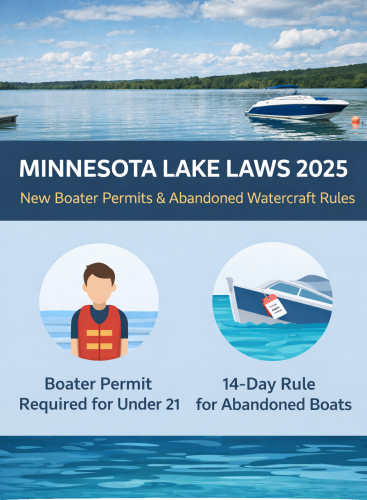
The first new law requires youth to hold a valid watercraft operator permit to operate motorboats or personal watercraft without supervision. This requirement went into effect on July 1, 2025. People born after June 30, 2004 (those under 21 per my Minnesota math) are now required to have this permit when operating motorized watercraft. If someone lacks the permit, they must operate only under the supervision of a qualified accompanying operator. In future years, the requirement will cover older age groups. Individuals born after June 30, 2000, must comply starting July 1, 2026. Those born after June 30, 1996, must comply beginning July 1, 2027. Finally, individuals born after June 30, 1987, must comply starting July 1, 2028. Bottom line is that people born after June 30, 2004, need the permit now, and that the requirement will expand gradually in the coming years.

A young operator under 12 years old may not operate any motorboat with more than 75 horsepower or any personal watercraft. A young operator may operate a low-powered motorboat under 75 horsepower, provided a qualified accompanying operator is aboard. The law defines this accompanying operator as a person at least 21 years old who is in the vessel, has immediate access to the controls, and either holds a valid operator permit or is an exempt operator.

If someone already holds the watercraft operator permit, they are not affected by the new law. Rentals are also regulated. Anyone 18 or older must have a valid permit to rent a boat or personal watercraft. Individuals under 18 are not permitted to rent such vessels.

To obtain the permit, individuals must complete an online boater education course and pass a test. After successfully completing the course and exam, a permit card is issued and must be carried when operating a motorized watercraft. The permit is valid for life.

Abandoned Watercraft

The second law addresses abandoned or neglected watercraft. If a vessel appears stranded, wrecked, or abandoned on public accesses or shorelines, officers may tag it and notify the owner. The owner then has 14 days to correct the condition. If the issue is not addressed within that period, the vessel may be seized and forfeited as abandoned property. Real authority is now granted to remove watercraft that block access, pose navigation hazards, or are left in a state of disrepair. The tagging and 14-day period are intended to give owners notice and time to respond before forfeiture may occur.

Homeowners should keep boats registered, maintained, and visibly in use to avoid misunderstandings. If a boat is tagged, the owner may need to show documentation that it is still in use or was only temporarily located there. Lake associations can assist by reminding members of the fourteen-day rule and encouraging proper stewardship of watercraft.

Conservation officers and county sheriffs enforce both new laws. The operator permit law is enforced similarly to driver licensing enforcement, and during checks, the permit must be presented on demand. Carrying the permit when operating a vessel remains essential. The abandoned watercraft law establishes a timeline for removal and permits forfeiture without the need for court proceedings. Keeping watercraft in clear working condition, properly registered, and not left at public access points is critical. Owners who store boats near shared access points or shoreline areas may consider posting notices or signage to prevent any misunderstandings.

By following these requirements, homeowners can avoid citations, forfeitures, or disputes. Staying informed about the legal requirements helps communities continue to use Minnesota’s lakes effectively and without interruption.

  • SPL


Super Lawyers names Mark Severson a 2020 Rising Star in Minnesota

Super Lawyers selects Severson Porter Law attorney, Mark Severson, as a Minnesota Rising Star in 2020.  Mark Severson has been previously selected as a  Minnesota Rising Star.

Super Lawyers, a Thomson Reuters business, is a rating service of outstanding lawyers from more than 70 practice areas who have attained a high-degree of peer recognition and professional achievement. The annual selections are made using a patented multiphase process that includes a statewide survey of lawyers, an independent research evaluation of candidates and peer reviews by practice area. Only the top 5 percent of attorneys in Minnesota are included in the annual Super Lawyers list.

Rising Star candidates must go through the same selection process as Super Lawyers but need to be either 40 years old or younger or in practice for 10 years or less. No more than 2.5 percent of attorneys in Minnesota are named to the Rising Stars list.

THE IMPACT OF COVID-19 ON BUSINESS AND REAL ESTATE TRANSACTIONS

By: Mark A. Severson
Board Certified Real Estate Specialist by the Minnesota State Bar Association

The devastating blow of the COVID-19 Virus has been felt by many in virtually all aspects of life, from Wall Street to Main Street.  Business has been essentially frozen as we all anxiously await positive developments.  The events of COVID-19 have certainly affected one’s ability to perform under previously agreed upon contracts. As we navigate this novel pandemic, we may wonder (a) does my contract address impossibility of performance due to a pandemic, or (b) what can I can do in a pure legal sense to protect myself against further devastation?  In terms of drafting contracts, there is a tool that has been used to address these concerns, dating back to the French civil law system.  “Force Majeure” is French for “superior force” and was intended to address “acts of God” for which no party to an agreement can be held accountable.

Specifically, a Force Majeure Clause is a contractual provision allocating the risk of loss if performance becomes impossible or impracticable, especially as a result of an event or effect that the parties could not have anticipated or controlled.  Including such a clause in a contract is an attempt of the parties to account for unexpected events or events that are so devastating it ought to excuse the parties from performance of the contract.  The terms can account for both acts of God (natural events, floods, hurricanes) and/or acts of people (riots, strikes, wars).  It is a provision that can effectively remove liability for natural and unavoidable catastrophes that interrupt the expected course of events and restrict parties to a contract from fulfilling their previously agreed upon obligations.

For contracts currently in place, a party may either invoke an existing Force Majeure Clause or request an amendment to include such a clause.  Without providing a full legal analysis, a contract containing a general Force Majeure Clause may not sufficiently apply to COVID-19.  Generally, Courts analyzing the issue must determine if it is a qualifying event, if the risk of nonperformance was foreseeable and able to be mitigated, and if performance is impossible.  A party is not able to invoke a Force Majeure Clause if it could have foreseen and mitigated nonperformance and, more importantly, if performance is merely difficult rather than impossible. Having COVID-19 classified as a pandemic is of great import to the question of whether a Force Majeure Clause is applicable.  If one is working under a government that has ordered certain businesses to not even go to work, and where remote operations are impossible, it would seem to make COVID-19 a qualifying event.

Locally, the invocation of a Force Majeure Clause came up with the Minnesota Twins and the Metropolitan Sports Facilities Commission.  The Twins attempted to invoke the clause when it learned that it would be contracted from Major League Baseball. In that case, the Twins argued they should be excused from the contract since they would be unable to play a home game for a reason beyond the Teams and the Commissions control, including strikes, an act of God, a natural casualty, or a court order. Ultimately, the Court sided with the Metropolitan Sports Facilities Commission and determined that the Twins would be in default of the agreement if they stop playing at the Metrodome, even if the team was removed from the MLB (in other words contraction by the MLB was not a qualifying event).

So what does this mean for us now? Parties may consider specifically accounting for the COVID-19 pandemic by agreeing it is a qualifying event. In drafting the language, like all provisions, it is critical to be specific and leave nothing to assumption.  A Force Majeure Clause is not the only means of “getting out of a contract” due to catastrophic events. A party may also argue the doctrine of “frustration of purpose” or “impossibility” as a justifiable reason to excuse one from contractual obligations. This is a doctrine that if a party’s principal purpose is substantially frustrated by unanticipated changed circumstances, that party’s duties are discharged and the contract is considered terminated.  This is essentially an excuse for a party’s nonperformance because of uncontrollable circumstances.  Of course, all parties are encouraged to honor their contracts; however, when performance is truly impossible, it is not dishonorable to apply principles of law that address the situation.

As you navigate this new world, and enter into contracts, raise this issue with your attorney or real estate agent so that it may be accounted for in your contract, should it be appropriate in your situation. Many real estate purchase agreement forms have already been revised to account for such a provision due to the devastation of this pandemic. Even if you wish not to have such a provision, be mindful of it as the other party to the contract may wish to include it.


Coronavirus disease (COVID-19)

As we all navigate these current events, please know that Severson Porter Law will remain ready, willing, and able to serve your legal needs throughout the crisis.

The Firm is following all recommendations from the CDC in maintaining a clean work space. The Firm has the technology in place to work remotely, if necessary, without losing any efficiencies or abilities.

Take care of yourselves and your loved ones. If anything from this crisis requires an adjustment to our service levels, scope of representation, or timing of performance of legal services, please let us know and we will accommodate. If anything is needed do not hesitate to contact Mark or Kurt to answer your questions.

Mark A. Severson & Kurt W. Porter

VARIANCES: Obtaining Permission to Vary from a Zoning Ordinance

Local governmental units, including but not limited to municipalities, townships, or counties, (referred to hereafter as “LGU”) enact zoning ordinances as a way to regulate real estate development. On a very basic level, most would agree that zoning ordinances are for the mutual benefit of the LGU and its residents. It is a means to obtain order and ensure zones of commonality. For instance, a zoning ordinance sets up a residential zone with a certain set of regulations of allowed uses as well as a commercial zone with a certain set of regulations setting forth allowed uses.  As the circumstances of a property and surrounding properties change, along with the applicable laws, sometimes it may not make sense to strictly enforce the letter of the law against a particular landowner seeking to develop his or her home or commercial property. If circumstances unique to the property can justify a landowner violating the zoning ordinance, then it may make sense for an LGU to allow that landowner to violate the ordinance.  This is why zoning ordinances typically have a promulgated process for permission to vary from certain provisions of the zoning ordinance (which, in other words, is permission to do something with your land that would otherwise violate the ordinance).

A variance is a way that an LGU may allow an exception to provisions of a zoning ordinance. A variance is a way to obtain clear permission from the LGU to depart from strict enforcement of the ordinance on an isolated and one time basis.  The typical variance application for a lake property is to obtain a more favorable setback restriction, either from the lake, the right of way, or the neighboring lot line.  A variance could be sought for a great number of reasons such as an increased building envelope, increased impervious surface allowance, greater height allowance, and so on. 

The process of obtaining a variance can vary depending on the LGU, but typically applications are first considered by the local “Board of Adjustment” or a planning commission or sometimes directly to the Township Board or City Council.  A variance can usually be appealed either to the Council or to the local District Court, depending on the particular zoning ordinance.

In order to successfully obtain a variance, an applicant must be able to prove that not providing the variance would cause practical difficulties for the landowner.  Minnesota has a three factor test for the LGU to consider in the decision to grant or deny a variance. All three factors must be met by the landowner to have the application approved. Additionally, the LGU must be able to state that the variance sought would be in harmony with the general purposes of the zoning ordinance (usually this means the variance is in line with the comprehensive plan).  Without going too in depth, the three aforementioned factors include, (1) the landowner proposes to use the property in a reasonable manner (this is somewhat of a judgment call for the LGU as to whether it might make sense to allow the subject property to have a less restrictive setback from the lake or the lot line, for example), (2) the landowner’s difficulty in complying with the zoning ordinance is due to circumstances unique to the property not caused by the landowner (for example, the topography of the land has certain limitations that may require a variance for placement of a septic mound), and (3) a granted variance cannot alter the essential character of the locality (for example, if all the homes in the locality or no more than two stories it may not make sense to allow a three or four story home that would stick out or alter the character of the neighborhood).

The consideration of whether to grant or deny a variance is public. Usually nearby landowners receive notice of an application as an opportunity to provide feedback. Although, as effective as it may be on some LGU councils/boards, neighbor feedback (positive or negative) is not a factor to approving or denying a variance.  Economic or personal concerns are also not factors. Many applicants without legal representation labor on the economic hardship that would be imposed if the variance sought is not requested. As much sense as that may make, it is not a factor that the governing body should consider.  Some applicants also labor over personal concerns such as handicap access or related needs. Notice too that those are not relevant factors for the governing body to consider. Although it is counterintuitive, neighbor feedback, economic and personal concerns are not factors in proving practical difficulties. That fact can be difficult for many applicants to understand.

Regardless of whether a variance is granted or denied, the findings supporting the decision are usually prepared in advance of the public hearing. For that reason, it is essential to have a complete variance application and to not save any arguments for the hearing. 

Notwithstanding the earlier comments regarding the technical irrelevance of economic concerns, on a pragmatic level, if a variance is granted it can significantly improve the value of the property. It may be prudent, then, to invest in sound legal representation to properly apply for a variance. The decision to have professional guidance in the variance process should be made at the very beginning of the process because, if denied by the LGU, a record is being built for appeal.  If the record is complete with reasons to support all three practical difficulty factors it may be possible to reverse the decision on appeal. However, the bar is quite high to successfully reverse the initial decision to deny a variance.

Knowing the process to grant or deny a variance is beneficial to those that object to a variance application as well. As real estate law firm, it is not uncommon to represent applicants and objectors. Most of the time the local governing board wants to make “the right decision” that invites the least conflict. If an application is prepared with these things in mind the chance of that application being granted increases. If an opposing position is prepared with these things in mind, the chance of that application being granted can decrease.

If you as a landowner or interested party could ever be impacted by a variance do not be afraid to discuss the issue with the local zoning administrator or a local real estate attorney.


Mark A. Severson

MSBA Certified Real Property Law Specialist

Severson Porter Law

mark@seversonporter.com